ANYEDIT: A Unified Framework for Speech and Singing Voice Editing with Real-World Acoustic Consistency
Abstract
Methodology
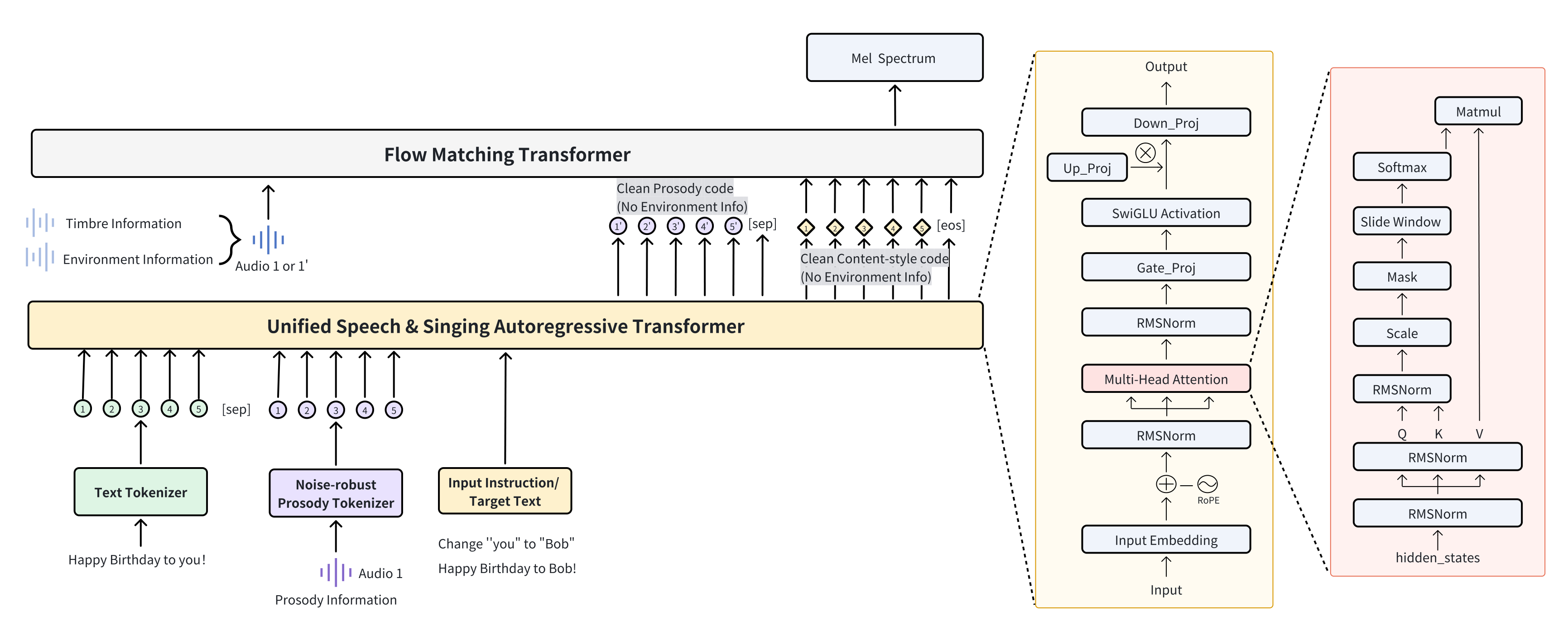
The AR model operates in a clean semantic space to predict prosody and content tokens, supported by a noise-robust teacher-student tokenizer. A flow-matching acoustic model then renders mel-spectrograms conditioned on source acoustic context.
ANYEDITBENCH
ANYEDITBENCH covers 12 subsets (3 splits × 2 modalities × 2 languages), totaling 600 evaluation items:
- Clean: single-span and multi-span edits on clean recordings.
- Simulated: diverse noise and reverberation settings.
- Real-world: in-the-wild speech and singing recordings.
🎧 Real-World Speech Editing
Orange highlight indicates edited words. Hover baseline cards to view listening notes.
🎧 Real-World Singing Voice Editing
Orange highlight indicates edited words. Red tags indicate acoustic conditions.
🎧 More Capabilities
Extra abilities beyond standard speech/singing editing. Orange highlight marks edited spans. Hover baseline cards for listening notes. For VC/SVC cards, the first reference is prosody/content and the second is target timbre.
Varying Length Editing
Original and target differ substantially in text length and/or audio duration. Hover baselines for failure modes.
Speech to Sing
Transfer a speech speaker’s timbre onto singing content/prosody.
Voice Conversion (VC)
Keep linguistic content/prosody while converting to a target speaker timbre.
Singing Voice Conversion (SVC)
Keep singing content/prosody while converting to a target singer timbre.